Asset recovery without borders: practical tools and shared challenges
24 June 2026
Caroline Ievers, Associate Director at Grant Thornton, rounds up discussions from a recent R3 and INSOL Europe restructuring event.
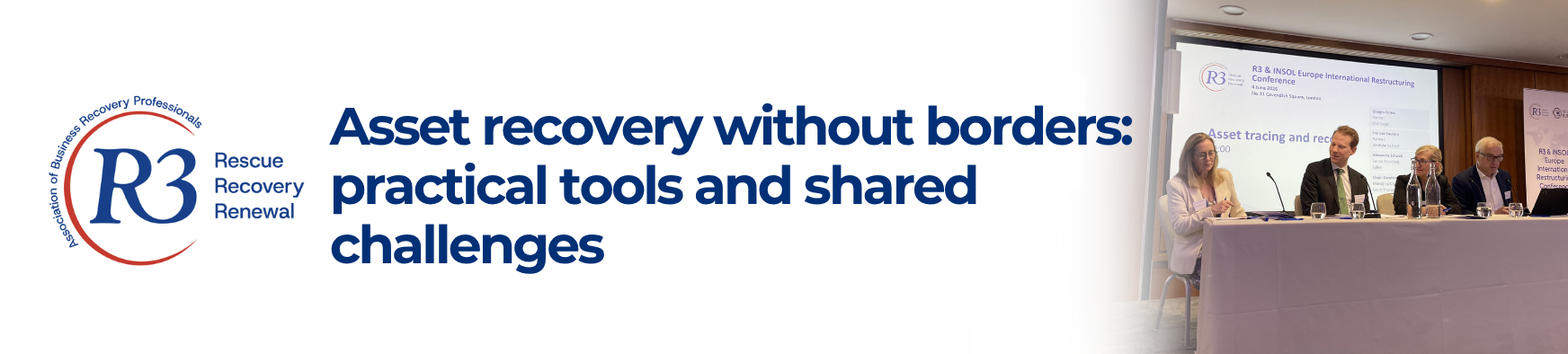
Cross-border asset tracing and recovery is often described as one of the most complex areas of restructuring and insolvency practice. That complexity was front and centre at the recent R3 and INSOL Europe restructuring conference, where a panel of UK, Italian and Swiss experts explored how different jurisdictions went about the process.
The session brought together different perspectives and a clear theme emerged: while each jurisdiction has its own legal frameworks, success in asset recovery depends less on any single rule or regime and more on how effectively practitioners combine tools across borders, act quickly and make strategic use of available information.
The UK: powerful tools, but at a cost
Frances Coulson, President of INSOL Europe and Head of Insolvency and Restructuring at Wedlake Bell, outlined why the UK remains one of the most sophisticated jurisdictions for asset tracing, particularly because of its flexible common law toolkit.
Disclosure mechanisms such as Norwich Pharmacal and Bankers Trust orders are important tools in the insolvency practitioner’s locker in obtaining information from third parties, often banks or intermediaries, in order to trace assets.
These powers are complemented by strong interim measures, notably freezing injunctions and proprietary injunctions, which can be deployed before or after judgment and even in support of foreign proceedings.
Another key strength is the integration of asset tracing with insolvency processes. Once proceedings are opened, officeholders gain access to investigatory powers (including under section 236 of the Insolvency Act 1986) and can pursue claims such as misfeasance, transactions at undervalue, or preferences.
However, the panel was clear about the downsides. The UK regime can be costly and resource-intensive, and court capacity can slow progress for non-urgent matters. Practical hurdles also arise from delays in obtaining financial information, particularly where banks are cautious or slow to comply.
Despite this, the UK continues to play a central role in cross-border cases. It is frequently used as both a disclosure hub – given the concentration of financial institutions – and an enforcement gateway.
Italy: structured access and EU-driven tools
Giorgio Corno, a dual-qualified Italian Avvocato and English solicitor who heads up SCAI Legal, explained the advantages of Italy’s official registers of tax, property, company and vehicles, which provide a comprehensive picture of a debtor’s assets and interests. The registers are accessible either to creditors holding an enforceable title, subject to a court’s organisation, or to officeholders, subject to a deputy judge authorisation.
Recognition and enforcement of foreign insolvency proceedings in Italian courts depends on their origin. Civil and commercial judgments, as well as insolvency-related judgments from EU member states are automatically recognised and can be enforced under the Brussels I bis framework, while those from outside the EU require an application to the Court of Appeal under domestic law.
A notable feature of the EU framework is the ability to use the European Account Preservation Order (EAPO), which allows in cross-border cases within the EU, a court in one EU country?to freeze funds?in the bank account of a debtor in?another EU country.
Looking ahead, recent EU legislative developments point towards greater harmonisation on asset tracing only. A new directive will expand access to both public and non-public registers, allowing insolvency practitioners to search national centralised bank account registers and locate assets on a cross-border basis through the EU's BARIS system across member states.
The direction of travel is clear: more transparency, more interconnected data and easier cross-border cooperation, although implementation timelines mean these benefits will take time to fully materialise.
Switzerland: a major asset hub with distinctive features
Alexandre Schwab, a Senior Associate at Swiss law firm LALIVE, commented that Switzerland’s position as a global asset hub means it is frequently a target jurisdiction in asset tracing and recovery efforts.
Its enforcement framework is relatively creditor-friendly: foreign judgments and arbitral awards can notably support ex parte freezing orders, and bank account attachments are a commonly used tool.
At the same time, Switzerland’s reputation for privacy and banking secrecy creates challenges. There is no broad discovery process and public registers are limited. As a result, asset tracing often requires alternative approaches.
One such route is the use of criminal proceedings. In cases involving alleged fraud, creditors and insolvency practitioners, once their office is recognised, can rely on prosecutorial powers to obtain banking and corporate records in addition to freezing assets. This route can bypass some of the constraints of civil proceedings.
Recognition of foreign insolvency proceedings remains a prerequisite for taking many actions locally, which can introduce delay. However, recent case law has introduced some flexibility, particularly in relation to the standing of corporate directors appointed by foreign officeholders.
Reform is also underway, including plans for a central beneficial ownership register. While access may initially be limited to public authorities, it could still improve asset tracing indirectly, especially where criminal processes are engaged.
Using the systems together
Perhaps the most valuable part of the discussion looked at how the different regimes work together in practice. The reality of modern asset recovery across borders is “multi-track” involving:
- Gathering intelligence through open sources, investigators and registers
- Using interim relief to prevent dissipation
- Pursuing recognition of foreign proceedings or judgments in parallel
- Combining civil, insolvency and (where appropriate) criminal tools.
The panel members stressed the importance of early coordination across relevant jurisdictions and speed. Early action, particularly freezing orders and disclosure applications, can make the difference between recovery and loss. Delays, whether caused by procedural requirements or practical barriers such as bank compliance, can allow assets to dissipate quickly.
Changing regimes across Europe
Across all three jurisdictions discussed, two themes stand out for the future:
First, access to information. Whether through EU directives or international frameworks such as the UNCITRAL toolkit and background notes on asset tracing and recovery in insolvency proceedings, there is a clear push towards better data availability and interoperability. Registers, from company ownership to bank accounts, are increasingly central to asset tracing.
Secondly, the legal framework is gradually adapting to new forms of assets and new ways of holding them, though often more slowly than practitioners would like. Panel members noted the need to modernise existing rules to account for digital assets, cloud-based data and evolving financial structures.
A shared conclusion
Despite their differences in asset tracing and recovery, the UK, Italy and Switzerland share a common challenge: balancing effective tracing and recovery tools with procedural safeguards, privacy rights and practical constraints.
The panel concluded that there is no single best jurisdiction for asset tracing. Instead, success lies in understanding how each system works, and in building strategies that leverage their strengths in combination.
What we learned from the discussion is that modern asset recovery is as much about coordination and sequencing as it is about the law with practitioners from different jurisdictions bringing together the right tools, in the right place at the right time.