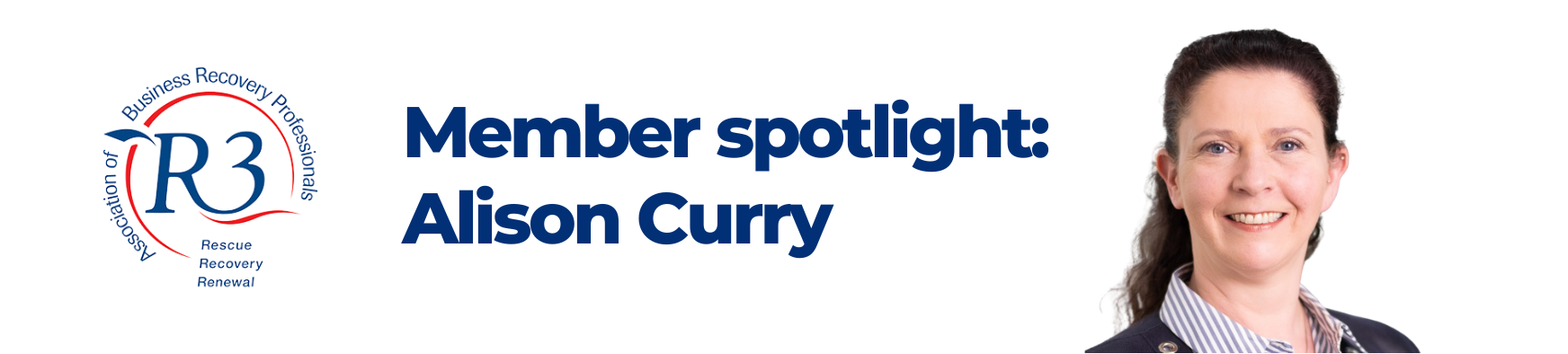
R3 Member Spotlight: Alison Curry
11 December 2024
Alison is a Licensed insolvency practitioner and Technical Manager at AlixPartners, with a background in both private practice and experience at a senior level within a regulatory body. She specialises in legal and regulatory compliance with an interest in the legislative developments that shape the work of the profession. Alison became an R3 Council member in April 2020 and has chaired the R3 Membership Committee since June 2023.
What made you decide to pursue a career in turnaround, restructuring and insolvency?
Insolvency practice was not a career I actively considered when I was studying for my law degree. As an idealistic teenager, I had fully intended to right the wrongs of the world by being a Perry-Mason-come-Helena-Kennedy styled barrister.
My introduction to insolvency practice came in 1996, almost entirely accidentally. I had graduated 2 years earlier and was self-funding my Legal Practice Course, at a time when there was a big slump in the number of law firms offering positions as an articled clerk. To compound matters, I was already a young mum with a second baby on the way. I had concerns about the feasibility of a daily commute to London and the implications that would have for my family life, not to mention the astronomical cost of childcare and how I was going to achieve anything close to a sensible work- life balance. So, I was very much at a crossroads in my life.
Having almost abandoned my ambitions, I saw an advert in my local newspaper for an insolvency administrator position - “Some legal knowledge preferred, but not essential. Full training given.” I attended the interview whilst visibly pregnant but was nonetheless offered the job by a forward-facing insolvency practitioner (certainly by 1990s standards, at least), with whom I remain friends to this day.
Over more than 28 years, insolvency and restructuring practice has delivered up an intoxicating mix of legal complexity, practical problem solving and real human impact, unlike any other profession I can imagine.
How did you get to where you are today?
Enjoying the assumption of personal responsibility, addressing each new challenge head on and believing in the value of what we do. (Tempered with a fairly thick skin and a good dose of pragmatism about how our work may be perceived by others!)
By the time I was an insolvency manager, studying for my JIEB (with 3 children by that point in time), I had completely embraced the notion that insolvency practitioners were the unsung heroes of the more mainstream legal and accountancy professions. I believed then, as I do now as a seasoned insolvency professional and mother of 4, that the economic and social value of what we do is enormous.
Is there a piece of advice you wish you’d been given at the start of your career?
This job really matters, but don’t always expect to be thanked by everyone for doing it well. Taking the time to properly explain to people the “hows” and “whys” of our work smooths the path to better outcomes for all.
What is the most rewarding aspect of your current role?
Without doubt, problem solving. There is never a vanilla case in our offices and my colleagues approaching me with “a quick question” invariably signals a happy foray into the tomes, exercising the little grey cells over some thorny issue or other in search of a creative solution.
A close second would be encouraging and supporting more junior colleagues to embrace the devil that lies in the detail of our work, hopefully imbuing a little of the enthusiasm I have for the intricate web of law and regulation we must navigate each day.
Since becoming an R3 member in 2015, which aspects of membership have you found most beneficial?
Networking with like-minded peers is a really useful way to understand what is going on in the broader marketplace - we are a small profession and need to avoid working in silos. Access to relevant training and CPD has been important over the years too. But probably above all (and perhaps not surprisingly, given my role) the wealth of technical materials that R3 produces is invaluable.
Can you R3 members more about the work of the R3 Membership Committee?
The R3 Membership committee historically focussed on considering applications for membership. The committee also had (and has) a role in pricing and broader initiatives to promote member retention.
In the last 18 months, the key focus of our work has been on the evolution of R3’s membership structure, in order to broaden the church and ensure that R3 can continue to be the leading representative force for the insolvency and restructuring community. This project culminated with the revision of R3’s articles and the introduction of new by-laws in September 2024, hailing the new era for R3.
With the effective completion of the project to rejuvenate both our individual membership structure and the Corporate Membership Scheme, the role of the Membership Committee must also now evolve to serve and promote the association’s aims. In the year ahead we will be working closely with other R3 Committees to devise new initiatives for enhancing member retention and growth, and promoting diversity and inclusion (within both our membership and the broader profession).
We are looking for new blood, so if you are interested in joining this group, please do drop me, or Shemin Varma, a line.
Contact:
Alison Curry, Membership Committee Chair
Shemin Varma, Membership Committee Secretary
How has the profession changed since you’ve joined it?
The profession has come a very long way from the “smoke-filled backroom boys club” image of old. But we are not there yet in achieving a truly diverse and inclusive profession that attracts the finest minds to help address the problems UK business will face over the coming years.
If you haven’t read the recently published Report to the Insolvency Diversity and Inclusion Steering Group: A Literature Review of Academic Research on Equality, Diversity and Inclusion in the Professions, I can only commend you to do so. It makes for a sobering read.
What do you consider as the biggest challenge for the insolvency and restructuring profession in the future?
With predictions of tough economic times ahead, it seems we are likely to be busy. Might we be too busy to avoid stumbling into another collective PR crisis and unwelcome regulatory reform?
Often the greatest measure of our profession’s successes are those engagements that no one hears about because of our collective, quiet professionalism. Whether that be the consensual restructuring of a business that has been achieved below the radar of the mainstream media; or the recycling of capital through assisting business leaders to put past failures behind them and start afresh; or the welcome relief from the burden of unmanageable debt that enables thousands of individuals to return to economic participation. These success stories are often go untold, either because we are simply unable to talk about them, or we are just too busy getting on with the next job in hand.
Perhaps that is precisely where having a strong representative body in R3 will demonstrate its value to us all.
 Dawn Boyall
 Amani Keynan
R3 members can provide advice on a range of business and personal finance issues. To find an R3 member who can help you, click below.