Four key takeaways from the 2024 R3 New Professionals Forum
24 June 2024
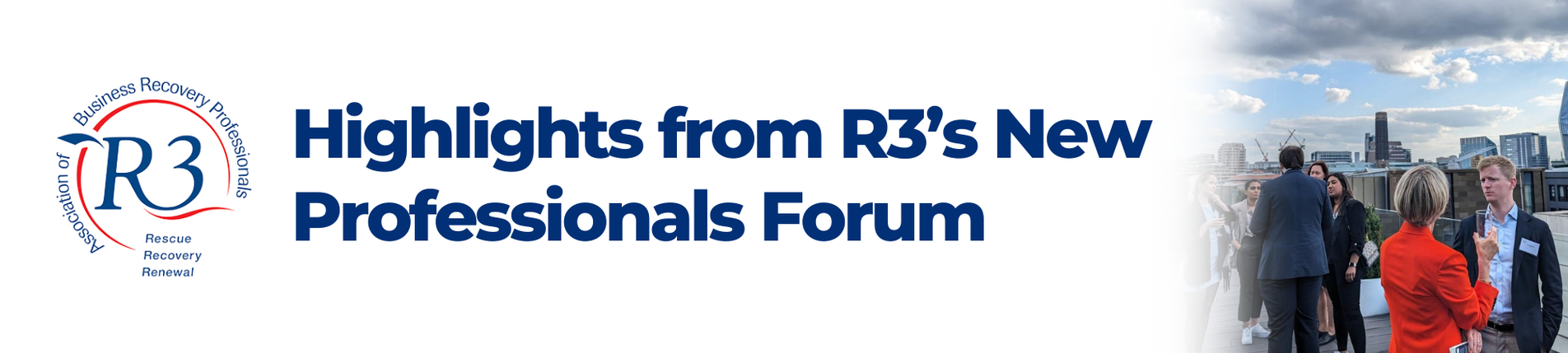
On 5th June, new professionals from the insolvency and restructuring profession, including recently qualified insolvency practitioners, solicitors, and accountants, came together for the sold-out R3 New Professionals Forum 2024.
Held in Wedlake Bell’s London office, the half-day conference delivered a variety of sessions from insurance to networking, the state of the economy and more. In this blog, we outline a few key takeaways from the day.
1. It may take some time to feel the effect of falling inflation.
Inflation in the UK has dropped significantly since hitting a staggering 11.1% in October 2022 - the highest rate in four decades. Fast forward to April 2024 and we have seen prices rise by only 2.3% over the past year, the closest we’ve come to the 2% inflation target in around three years.
This fall has been largely driven by a slowdown in food and energy price rises, while wages in real terms have risen. Yet despite these improvements household spending remains cautious. So, if the economy is stabilising and wages have gone up, why are we not also seeing a rise in spending?
As Kabir Seehra, Senior Manager at Teneo, explained in the first session of the day, the answer lies in the delayed impact of falling inflation. A fall in the increase of costs of groceries and everyday items may be starting to trickle through, but housing costs are still significantly higher than they were pre-pandemic, putting an enormous strain on the finances of anyone with a mortgage or paying rent.
At the same time, the cost of debt remains high. Interest rates have failed to fall in line with inflation, so for the many people that accumulated debt during the worst of the pandemic and the cost-of-living crisis, that debt is becoming more expensive and taking much more time to clear. So, while wages have increased for lots of people across the UK, there’s still a long way to go before the full benefits of reduced inflation can be felt by most households.
2. Our aging population is on the cusp of becoming a significant concern.
In his session on the economy, Kabir Seehra also spoke about the economic impact of our aging population. While it isn't a factor that's unique to the UK, it is something we should be concerned about.
Data shows us that the UK’s workforce is getting older and there aren't enough young people to fill the soon-to-be vacant positions. This means we’re on the verge of losing knowledge and vital skills, while at the same time having fewer professionals ready to take over when the older generation retire. Many sectors have vocalised concern on this issue, from construction to manufacturing, as well as our own profession.
R3 is aware of how important it is that essential skills and knowledge don’t disappear with the retiring generation and is working on new ways to attract and retain young talent into the insolvency and restructuring profession, including running training programmes and events and making sure that new professionals have a seat at the table to ensure their voices are heard in discussions on key issues.
3. Don’t be afraid to ask questions.
In a session on investigations, claims and director duties, speakers from HCR Law, Kroll, FRP Advisory and Crowell & Moring UK discussed top tips when interviewing a director about a claim. The panel emphasised that gathering information is the most important aspect of the job and that there’s truly no such thing as a stupid question when conducting an investigation.
Their advice: when talking to directors, go through the timeline of events chronologically and ask open-ended questions to uncover as much detail as you can.
The panel also stressed the importance of preparation: have all your questions ready and all the necessary documents such as invoices on hand, so nothing gets overlooked during interviews. Being thorough and methodical in your approach is key to a successful investigation.
4. Understand your network to build the right connections.
Networking is crucial for insolvency and restructuring professionals and it’s especially important when you’re just starting out in your career. You're meeting new people and forming relationships that could last a lifetime. But to network efficiently, it's important to understand what your network looks like.
In the final session of the day, Antoinette Dale-Henderson from the Gravitas Programme explained how visualising your network as a map can help you track what connections you have and what connections you want to make. Your local network includes those closest to you – colleagues, peers and others at the same level who are easily accessible. Your national network consists of people currently beyond your immediate reach, like senior managers, industry experts and influential contacts within your firm and competitor firms. Finally, your global network encompasses the leaders in your field – those at the very top.
By mapping out your network, you can strategically focus on who to spend time with, ensuring you make meaningful connections without wasting anyone’s time.
Finally, Antoninette emphasised that while many people find networking daunting, it’s important to remember that it’s just a conversation. Everyone has something in common, so find that common ground and the rest will come easily.
 Dawn Boyall
 Amani Keynan
R3 members can provide advice on a range of business and personal finance issues. To find an R3 member who can help you, click below.